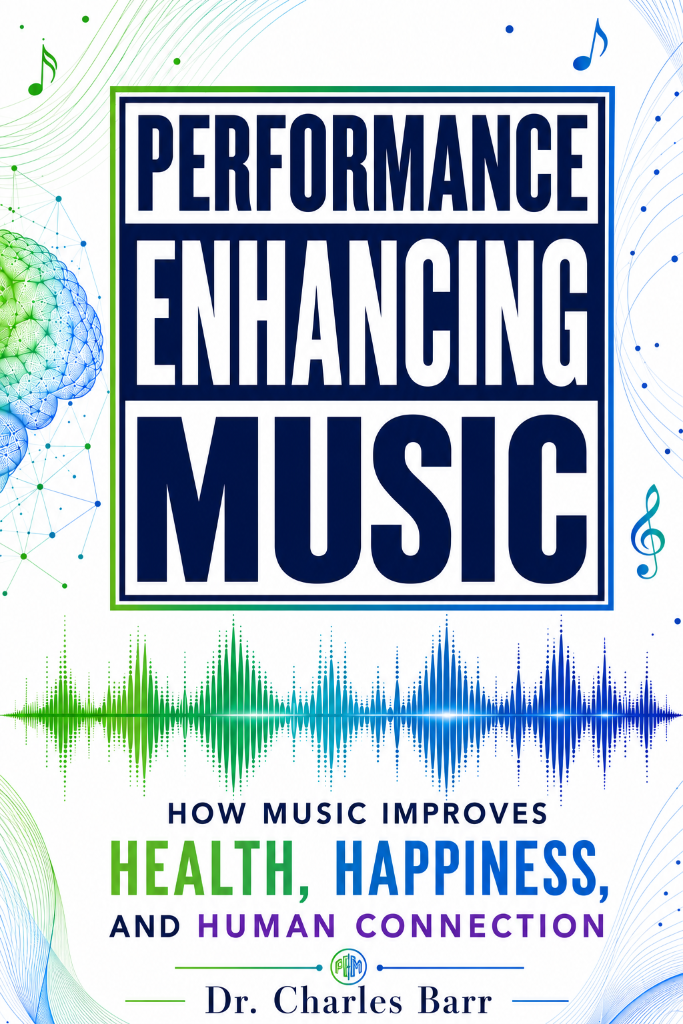
A chapter from Performance Enhancing Music
Affirmations in Motion — Why Sung Messages Stick
CHAPTER 10 · ALL ARTISTS
The Chapter Soundtrack
Songs inspired by this chapter from Roots in Wisdom, William y Mookie, and Frank Dialekt. Tap a tile to stream on YouTube.
Blue on Blue
Ch. 10 · Roots in Wisdom
The Podcast · Episode 10
The Video · Chapter 10
Summary
Chapter 10 explains why affirmations set to music work when spoken ones fall flat. In three controlled experiments at Duke, Wallace (1994) showed that people recall sung text far more accurately than spoken text, with melody functioning as a mnemonic scaffold — the same principle behind the ancient Method of Loci used by Greek and Roman orators. A phrase that would evaporate as a flat mirror-affirmation lodges permanently when it rides a melody. This is why the songs of our youth stay word-perfect for life.
From this comes the idea of the interior choir: the two or three songs that surface unbidden in hard moments and function as your inner voice. Dr. Barr's examples — Des'ree's 'You Gotta Be,' India.Arie's 'Strength' — are character checklists set to music, still running through his head before something hard. The practice is to identify the songs that already serve this role, label each by the state it reliably produces (resolve, confidence, calm, courage), and build the choir deliberately so you always have the right voice on hand.
The chapter's deepest move is aspirational. When you're reaching for something not yet true — a goal, a harder version of yourself — you pick a song that expresses that state, not how you feel now, and play it on loop with active intention while you work toward it. Intention plus repetition is the mechanism; and the most active form of becoming is to learn the song and sing it. It's a gift worth handing to children, too: help them find their 'you gotta be stronger' song before they need it, so they carry an interior voice into the hard days you won't be there for.
Wallace (1994, Duke University) — sung text is recalled far better than spoken — melody as a mnemonic scaffold
Wallace (1994, Duke University) — Melody as Memory Scaffold
Across three experiments, people recalled the words of a ballad far more accurately when sung than spoken — melody functions as a mnemonic scaffold. Why it matters for PEM: it's why sung affirmations stick where flat mirror-affirmations fail, and why your interior choir lasts for life.
The Method of Loci (Cicero) — The Orators' Technique
The ancient memory method embeds information in a structured scaffold (a journey through familiar rooms) to boost recall — the same principle as melody. Why it matters for PEM: structure is what makes information durable, and music is a portable structure you carry everywhere.
Key Takeaways
Sung words stick; spoken words fade. Melody is a mnemonic scaffold — sung text is recalled far more accurately than speech (Wallace, 1994).
Song beats the mirror. Flat mirror-affirmations fail where a melody succeeds, because music binds the message to memory and emotion.
You already have an interior choir. Name the two or three songs that surface unbidden in hard moments — that's your inner voice, already at work.
Label songs by the state they produce. Resolve, confidence, calm, courage — tag each so you can reach for the right voice on demand.
Reach for who you want to be. Pick a song that expresses the state you intend, not the one you're in — then loop it while you work toward it.
Intention plus repetition is the mechanism. Don't just listen; consciously reach toward the state as it plays, and repeat.
Learn the song to go deepest. Playing and singing it is the most active form of becoming there is — and a gift to give your kids early.
Journal
Your reflections are private — saved only on this device.
What's the oldest song you know by heart — words you can still sing from a time you can barely otherwise remember? What does it feel like when the opening bars arrive?
Is there a belief, a goal, or a version of yourself you're reaching toward right now? What song expresses it — and what would happen if you let it play on loop while you reached?
Which two or three songs already function as your inner voice in hard moments? What state does each one produce?
What 'you gotta be stronger' song would you hand a child in your life before they need it?
References
The studies behind this chapter — the full reference and what each one found.
- 1
Wallace (1994, Duke University) — sung text is recalled far better than spoken — melody as a mnemonic scaffold
Across three experiments, people recalled the words of a ballad far more accurately when sung than spoken — melody functions as a mnemonic scaffold. Why it matters for PEM: it's why sung affirmations stick where flat mirror-affirmations fail, and why your interior choir lasts for life.
- 2
The Method of Loci (Cicero) — the ancient orators' memory technique exploits the same scaffolding principle
The ancient memory method embeds information in a structured scaffold (a journey through familiar rooms) to boost recall — the same principle as melody. Why it matters for PEM: structure is what makes information durable, and music is a portable structure you carry everywhere.