

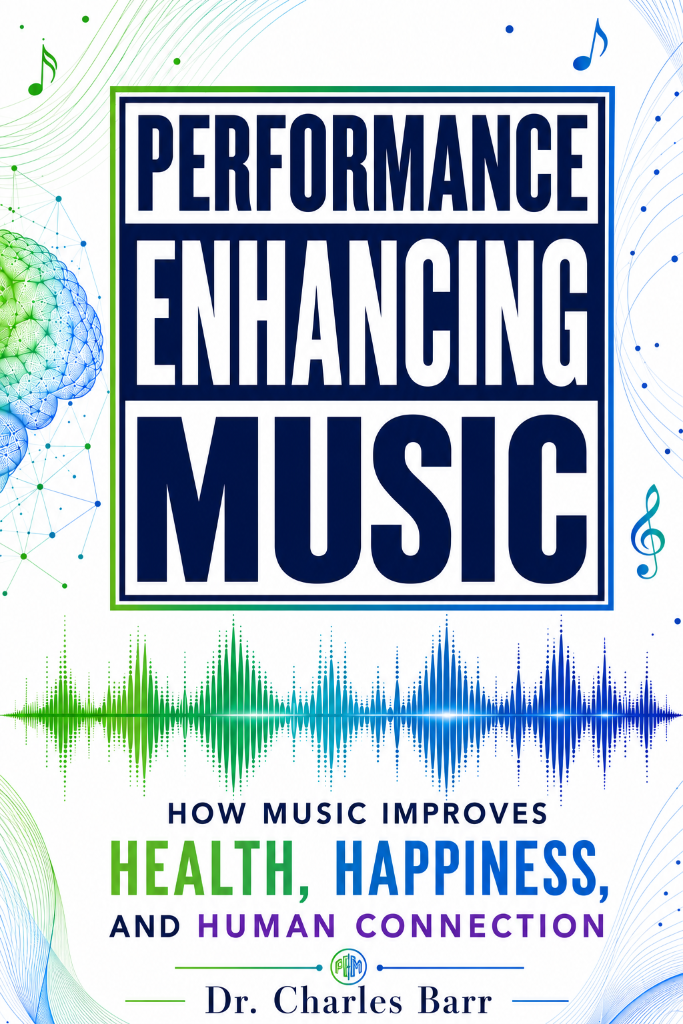
A chapter from Performance Enhancing Music
The Forward-Motion Playlist — Resilience and Grit
CHAPTER 14 · ALL ARTISTS
The Chapter Soundtrack
Songs inspired by this chapter from Roots in Wisdom, William y Mookie, and Frank Dialekt. Tap a tile to stream on YouTube.
Before You Know It
Ch. 14 · Roots in Wisdom
The Podcast · Episode 14
The Video · Chapter 14
Infographic
Infographic placeholder
Content coming soon.
Summary
Chapter 14 is about resilience, and it corrects a common misuse of music. Ferguson and Sheldon (2013) found that positive music alone did not reliably lift mood — only the combination of positive-valence music and the listener's active intention to feel better produced significant, sustained improvement. Passive listening is not enough; the intention is the engine. Fredrickson's Broaden-and-Build theory supplies the payoff: positive emotions don't just feel good, they expand the cognitive and behavioral repertoire in the moment, which is how a lift becomes real forward motion.
The distinction Dr. Barr draws is between coping and reaching. Some songs match your misery and keep you there — a place people stay. Others help you keep moving while you're still in the difficulty. The Forward-Motion Playlist is built from the latter: songs that carried you through hard times, not songs about being happy. And you use it with intention — you don't just press play and wait; you actively reach toward the state you want while it plays.
For the deepest moments, the chapter says to go further than listening: learn the song. Playing, singing, and internalizing the words is the most active form of reaching there is — and for grief specifically, choosing a song that honors who you lost and letting the learning of it become your way of processing turns the song into a place to keep them. As with pain and sleep, the instruction is to keep the playlist built and ready, because adversity doesn't schedule itself. The chapter closes on music after war — the deepest testament to music's power to carry people forward.
Ferguson & Sheldon (2013) — positive music plus active intention produced sustained mood improvement — passive listening did not
Ferguson & Sheldon (2013) — Intention Is the Active Ingredient
Only the combination of positive-valence music AND the active intention to feel better produced significant, sustained mood improvement; passive listening did not. Why it matters for PEM: don't press play and wait. Reach actively toward the state you want while the music plays.
Fredrickson (2001) — Broaden-and-Build
Positive emotions don't just feel good; they expand the cognitive and behavioral repertoire in the moment, building lasting resources over time. Why it matters for PEM: it's the mechanism by which a musical lift becomes real forward motion and resilience.
Key Takeaways
Intention is the active ingredient. Positive music lifts mood only when you actively intend it to (Ferguson & Sheldon, 2013). Passive listening isn't enough.
Positive emotion broadens you. It expands what you can think and do in the moment (Fredrickson) — how a lift turns into forward motion.
Reach, don't just cope. Some songs match your misery and keep you there. Choose music that expresses the state you want to reach.
Build a Forward-Motion Playlist. Songs that carried you through hard times — not songs about being happy, but ones that kept you moving.
Reach actively as it plays. Don't press play and wait. Consciously move toward the better state while the music runs.
Learn the song to go deepest. Playing and singing it is the most active vehicle for reaching there is.
Keep it built before you need it. Adversity doesn't schedule itself. Have the vehicle fueled and ready.
Journal
Your reflections are private — saved only on this device.
What's the song you reach for when life has knocked you down — not the one you think you should, but the one you actually do? What does it do that nothing else manages?
Is there a loss, a wound, or a chapter that hasn't found its form — something that might benefit from being set to music, just privately? What would the song sound like?
Which of your songs help you cope (and stay) versus reach (and move)? How would you tell them apart?
What would it mean to learn — not just listen to — the song that carries you, and let the learning become how you process?
References
The studies behind this chapter — the full reference and what each one found.
- 1
Ferguson & Sheldon (2013) — positive music plus active intention produced sustained mood improvement — passive listening did not
Only the combination of positive-valence music AND the active intention to feel better produced significant, sustained mood improvement; passive listening did not. Why it matters for PEM: don't press play and wait. Reach actively toward the state you want while the music plays.
- 2
Fredrickson (2001) — Broaden-and-Build — positive emotions expand thinking and action
Positive emotions don't just feel good; they expand the cognitive and behavioral repertoire in the moment, building lasting resources over time. Why it matters for PEM: it's the mechanism by which a musical lift becomes real forward motion and resilience.